
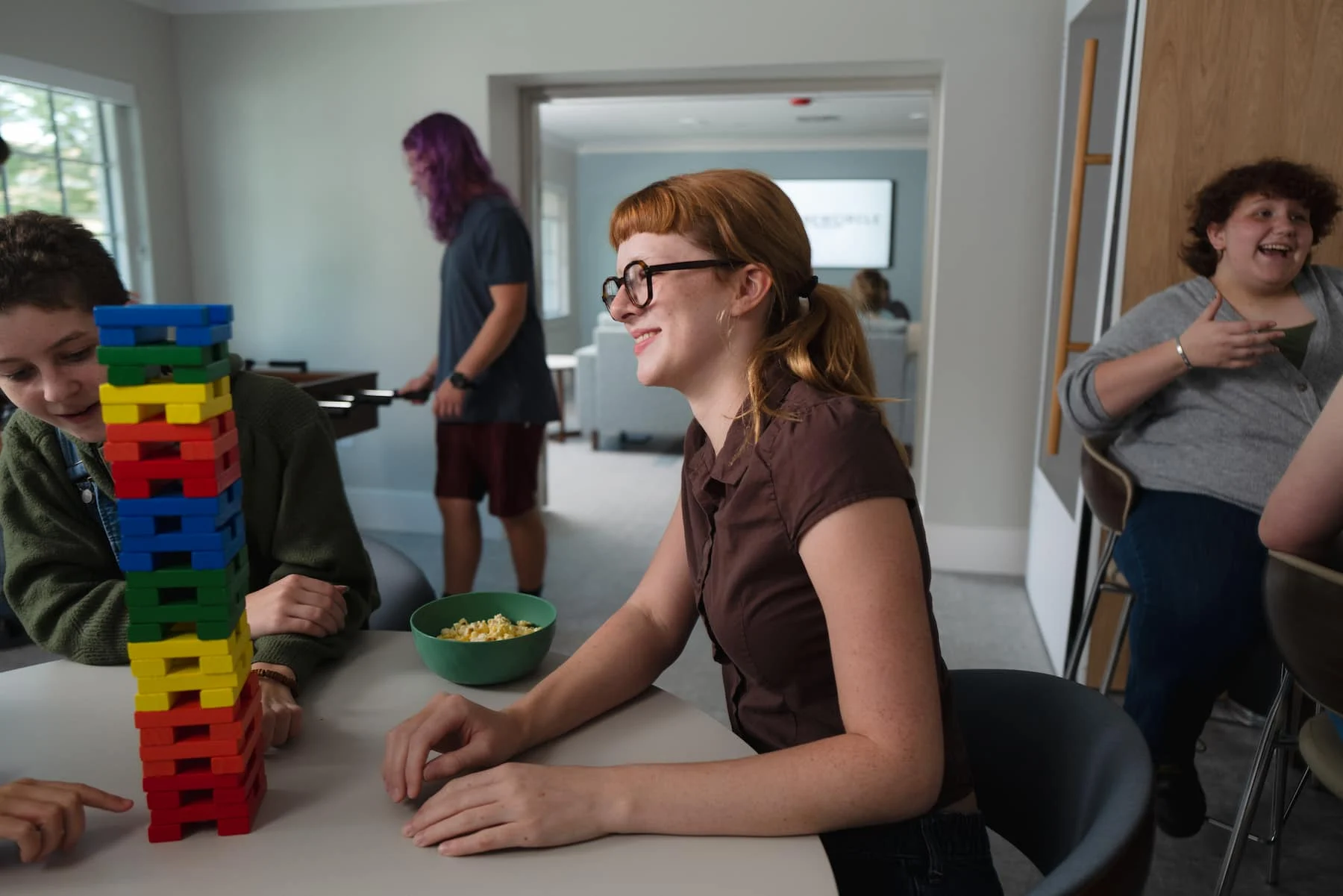
teen playing a board game

What is a Residential treatment program?

Residential eating disorder treatment at NewCircle provides 24/7, immersive care for individuals with eating disorders who need greater support than outpatient or partial programs can offer.

We offer programming for both teens (13+) and adults of all genders and identities, designed for those in need of structure, medical monitoring, and focused therapeutic care. Combining evidence-based treatment with relational and creative approaches, daily rituals include individual therapy, group therapy, group sessions, supported meals, and time for reflection and joy in our thoughtfully designed residence. Every part of the program is tailored for whole-person care.

A place of healing and belonging

We firmly believe that healing doesn’t happen in isolation, but instead occurs in community. In our residential program, you’re met with compassion and respect from the moment you arrive. Whether you’re navigating anorexia, bulimia, binge eating, ARFID, OSFED, or another eating disorder, our residential treatment program offers a safe landing place to recognize and disrupt old patterns, discover a new relationship with nourishment, and restore your sense of self.

This is a place for realignment with your body, your values, and your life beyond the disorder. Our team is here to listen and provide you with the support you need for true healing.

people with dog

Benefits of Residential eating disorder treatment

Ready to start your journey?

Begin your healing journey in a space designed for restoration. Our admissions team is here to guide you with warmth, transparency, and care. Whether you’re ready now or just exploring, we’re here to listen and support your next step.

How it works

What happens after Residential treatment?

Recovery is ongoing—and we stay connected. After residential care, most clients transition to a lower level of support such as PHP or IOP, where they continue therapeutic work while gradually reintegrating into daily life. Our team helps you build a sustainable aftercare plan that may include:

  • Ongoing therapy or support groups
  • Nutrition and meal support
  • Relapse prevention strategies
  • Family involvement or coaching
  • Referrals to local providers when needed

You’ll leave with a clearer sense of self, tools for staying grounded, and a community that’s still here when you need us.

755b6abd210dc09e4df5cad646e68e8f6baea8c8

NewCircle Reviews

“After my whole life of never being sure I could get help, this place blew me out of the water. I have fully graduated out of the program and my life is forever changed. All of the staff are amazing individuals who are there to really change lives. The facility is beautiful and has so many amazing qualities that it would take me pages to describe them. If you need help, I HIGHLY recommend here!”

– Residential Alumni, NewCircle
Date: 1/6/2026

“New Circle really did change my life for the better. I completed two months of Res and a month of PHP. The RC’s (especially Timmy) are fantastic and wonderful. Larry is the best intake coordinator in the WORLD (so kind and communicative!). The clinicians helped me work through so many struggles and to build a support system at home. This treatment program is SO individualized; it is able to meet the needs of so many individuals. There are so many things I could say, so I will leave it on this note…. If you are considering coming to New Circle, yes. Come, without a doubt. I am in a larger body, and that did not negatively impact my treatment whatsoever. I felt very accepted by staff. After struggling with my eating disorder from early childhood into adulthood, I’m finally able to see a life for myself without bulimia.”

– Residential & PHP Alumni, NewCircle
Date: 3/10/2026

“I would suggest this program to anybody struggling with an eating disorder. This program is so supportive and positive the people who work here really care about their jobs and the effect they have on others. From therapists all the way to nursing, everyone here is amazing!! If you’re struggling in any way, please call NewCircle.”

– Program Alumni, NewCircle
Date: 2/20/2026

Frequently asked questions

Residential treatment is the right fit when someone needs more support than they can get from a few sessions a week. That might mean medical instability that requires monitoring around the clock, a home environment where recovery feels impossible to sustain, patterns that have persisted through outpatient attempts, or a level of daily disruption that makes functioning feel out of reach. It doesn’t have to be a crisis to qualify. Some people come to residential care because they’re exhausted from trying to manage alone, and they’re ready for a complete change of environment. If you’re not sure whether residential is the right level, that’s exactly what our admissions process is designed to figure out together. Let’s talk through it. →

Not at NewCircle. This is one of the most common fears people bring to that first call, and it’s worth addressing directly. Our residential facility was specifically designed and remodeled to feel like a home, not a clinical setting. Clients stay in private suites with walk-in showers and thoughtfully furnished spaces that feel warm and personal. The common areas are open, comfortable, and newly designed with the same intention: to create an environment where healing feels possible rather than institutional. We do have full-length mirrors throughout the facility, which we want to be transparent about. This is intentional. Becoming comfortable seeing yourself in a mirror while you have clinical support around you is part of building body tolerance that holds after treatment. Avoidance often becomes a trigger once someone returns home, and we’d rather address it while we’re right there with you. The facility feels like a place people actually want to be. That’s not an accident.

Structured, but not rigid, and genuinely nothing like what most people imagine. Mornings typically begin with a supported breakfast, followed by individual therapy, group sessions, and skills work throughout the day. Afternoons include creative and movement-based activities — art, music, ceramics, yoga, dance — alongside nutrition support and time with our registered dietitian team. Evenings are quieter and more communal: dinner, reflection, connection with peers in our comfortable shared spaces. There’s also time built in for rest, personal care, and just being a person outside of the therapeutic work. Our facility is designed for all of this — open, warm, and newly remodeled so that every part of the day feels grounded and supported rather than clinical. No two days are identical, and your schedule will be shaped around your individual plan. But you’ll rarely feel like you’re waiting for something. There’s always something worth showing up for.

Yes, and family involvement is something we actively encourage rather than just permit. For clients whose families want to be close during treatment, whether they’re local or traveling from out of state, NewCircle has furnished apartments available specifically for families and loved ones. They’re comfortable, private, and close enough that being present feels manageable rather than logistically overwhelming. For out-of-state families especially, knowing there’s a place to stay that isn’t a hotel room for an indefinite stretch makes a real difference. Beyond physical proximity, family therapy and psychoeducation are built into our programming. Visits, family sessions, and the level of involvement are all structured around what’s clinically appropriate and what feels right for the individual client — not a one-size policy. Reach out to talk through what family involvement can look like. →

Yes. NewCircle works with many major insurance providers, and residential eating disorder treatment is a covered benefit under most plans. We understand that the financial commitment of residential care feels significant, and we don’t want that to be the thing standing between someone and the help they need. Our admissions team will verify your benefits before you make any decisions, walk you through what your coverage actually means in plain language, and help you understand what to expect. The verification takes about two minutes. Check your coverage now or call us and we’ll do it together. →

The main difference is structure and setting. In our residential program, you live at NewCircle full-time — meals, therapy, evenings, and overnight care all happen within the facility with 24/7 clinical support. In our Partial Hospitalization Program, you come for structured daytime care five to six days a week and return home or to supportive housing each evening. Residential is typically the right fit when someone needs complete immersion — whether because of medical monitoring needs, a home environment that makes recovery difficult, or a level of severity that requires around-the-clock support. PHP is a strong option for those who are medically stable but still need intensive daily structure. Many clients move from residential to PHP as a natural step-down once they’ve built stability and are ready to start practicing recovery in a more independent setting. Learn about our PHP program →

Discharge isn’t an ending — it’s a transition we plan for from the moment you arrive. Most clients step down from residential into our PHP or IOP program, continuing the therapeutic work at a less intensive level while beginning to reintegrate into daily life. Before you leave residential, your team will have built a personalized aftercare plan with you that may include ongoing therapy, nutrition follow-up, relapse prevention strategies, family involvement, and referrals to local providers when you’re ready. We stay connected through that transition because we know the weeks after discharge can be some of the most important in recovery. You won’t leave and wonder what comes next.

Our residential program treats the full range of eating disorders — anorexia, bulimia, binge eating disorder, ARFID, OSFED, and related presentations that don’t fit neatly into a single category. We also provide integrated care for co-occurring conditions like anxiety, depression, OCD, PTSD, and trauma that frequently accompany eating disorders. If you’re not sure whether your diagnosis or presentation qualifies, that’s worth a conversation — we treat the person, not just the diagnosis.

Yes. NewCircle provides completely separate programming for adolescents ages 13 to 17 and adults, each with their own peer group, therapeutic structure, and age-appropriate activities. Teens in our residential program receive developmentally specific care with family involvement built in, academic coordination when needed, and a clinical approach that accounts for where they are in life. Adults have their own track with the space and peer community that recovery at that stage requires. The two populations share the facility but operate in distinct therapeutic environments. Learn about our adolescent program →

It is. We believe that everyone who needs care deserves to receive it in a place where they feel genuinely safe and respected — not just accommodated. Our team reflects a range of backgrounds, identities, and lived experiences, and we’ve built dedicated programming for LGBTQ and BIPOC communities because we know that identity shapes the experience of an eating disorder, and it should shape the experience of treatment too. Whoever you are and wherever you’re coming from, there is a place for you here.

Most clients stay between 30 and 45 days, though some stay longer depending on clinical need and progress. Length of stay isn’t predetermined; it’s something we reassess throughout treatment based on how things are going and what makes sense for your recovery. What we can say is that we won’t rush you out before you’re ready, and we won’t keep you longer than is genuinely helpful. When the time comes to transition, we’ll plan that step carefully with you.

Sources

  1. National Eating Disorders Association. (n.d.). Treatment: Levels of care. https://www.nationaleatingdisorders.org/levels-of-care/
  2. National Institute of Mental Health. (2024). Eating disorders. U.S. Department of Health and Human Services. https://www.nimh.nih.gov/health/topics/eating-disorders
  3. Academy for Eating Disorders. (n.d.). Medical care standards guide. https://www.aedweb.org/resources/publications/medical-care-standards
  4. National Institute for Health and Care Excellence. (2017). Eating disorders: Recognition and treatment (NICE Guideline NG69). https://www.nice.org.uk/guidance/ng69
  5. Mayo Clinic. (2023). Eating disorders — Diagnosis and treatment. https://www.mayoclinic.org/diseases-conditions/eating-disorders/diagnosis-treatment/drc-20353609
  6. National Eating Disorders Association. (n.d.). Body image. https://www.nationaleatingdisorders.org/body-image-and-eating-disorders/
  7. American Art Therapy Association. (n.d.). About art therapy. https://arttherapy.org/about-art-therapy/
  8. American Music Therapy Association. (n.d.). What is music therapy? https://www.musictherapy.org/about/musictherapy/
  9. Academy of Nutrition and Dietetics. (n.d.). Eating disorders. https://www.eatright.org/health/diseases-and-conditions/eating-disorders
  10. National Alliance on Mental Illness. (2023). Eating disorders. https://www.nami.org/About-Mental-Illness/Mental-Health-Conditions/Eating-Disorders
  11. American Academy of Child and Adolescent Psychiatry. (2011). Teenagers with eating disorders. https://www.aacap.org/AACAP/Families_and_Youth/Facts_for_Families/FFF-Guide/Teenagers-With-Eating-Disorders-002.aspx