
When people hear that I’m a music therapist, they often picture a sing-along or a talent show. Some of the people I work with at NewCircle walk into the music room bracing for exactly that, worried they’ll be asked to perform. Over 10 years of practice, I’ve worked with people as young as 2 months old in the NICU and as old as 102 in hospice, and every one of those sessions has centered on connection. In eating disorder treatment, the music room can become a place where a person is finally allowed to be loud and imperfect.
Music Therapy and Its Goals
Music therapy is the evidence-based practice that uses music to achieve non-musical goals. As a music therapist, I don’t focus on whether a client can sing in tune or play a rhythm correctly. Music serves as a catalyst for addressing needs and behaviors that support recovery. At NewCircle, I often use music as a creative way for clients to express themselves, process emotions, and learn new skills they can use outside of treatment.
Board-certified music therapists complete a degree in music therapy, supervised clinical training, and a national certification exam, and we recertify every five years to keep our skills current. Sessions can center on playing instruments, songwriting, listening, or improvisation, depending on what a person needs that day. For many people with eating disorders, feelings are hard to put into words, and music offers another way to reach them.
Taking Up Space
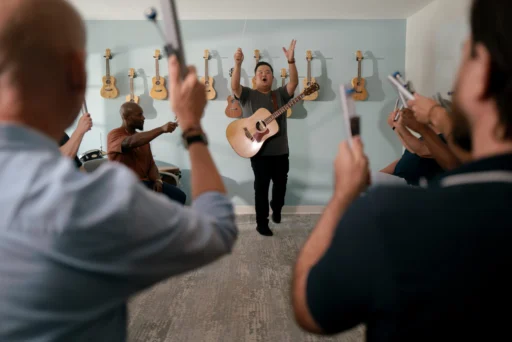
It’s common for those with eating disorders to want to take up minimal space, regardless of the body they’re in. In the music room, clients often don’t want to play an instrument loudly because it takes up the sound space. They don’t want anyone to hear them or see them play because they might “mess up.” I often challenge the idea of perfectionism. A recurring belief among clients is that if they aren’t “perfect” at something, they don’t deserve to participate or enjoy themselves.
To push back on that belief, I’ll hit the drums as hard as possible or play my guitar at max volume to demonstrate, “Hey, this is a safe place for you to take up as much space as possible.” If you come into my music room, you’ll see that the cymbals on the drum set are warped and bent. I encourage clients to hit the drums as hard as they can. One, it releases a lot of pent-up energy. Two, it allows clients to express themselves unapologetically. Most importantly, it reminds them to HAVE FUN. I reassure clients that everyone within a 10-mile radius has already heard me jam out.
Songwriting and Belonging
Songwriting also supports emotional regulation and expression. I’ve written original songs with clients, with original lyrics and melodies, to motivate recovery, explore complex emotions, and promote group cohesion. We’ve written songs about a client’s cats, with a chorus of “meow, meow meow meow, meow meow meow.” For this client, returning to their cats was a huge motivator for recovery. Shout-out to the cats: Lexi the Pwincess Baby, Mister the Man Pwince and Emmy the Fierce Pwincess.
We’ve also written songs about the state of the world and how it makes us feel. Some feelings are too big or too tangled to talk about directly, and shaping them into lyrics and a melody gives a group something concrete to work through together. We’ve taken our original compositions, sung them as a group and formed a rock-and-roll band. Clients often feel alone in their recovery journey. Writing a song as a group, singing it together, and then rehearsing it as a band creates a sense of belonging and community.
Skills Beyond Treatment
Recovery can be difficult and arduous. I often teach clients how to play an instrument as an appropriate leisure-time activity. Instead of ruminating on dark thoughts, clients can learn to play the ukulele or the drums, replacing negative behavior with a skill that can last a lifetime! A skill like this travels with a person long after treatment ends. On a hard evening, picking up an instrument can offer a few minutes of focus and a reminder of how recovery felt in the music room.
One of my biggest dreams for NewCircle is to create an alumni band, where local alumni can come together once or twice a month to jam. It would be a group where alumni support each other and keep each other accountable, with plenty of noise along the way.
Room to Be Heard
No one needs musical experience to walk into the music room. What I hope people leave with is the knowledge that they’re allowed to be heard, mistakes and all. If you or someone you love is struggling with an eating disorder, the NewCircle team is here to talk through treatment options and answer your questions. Reach out to learn more about our approach to care, music room included.
Author bio
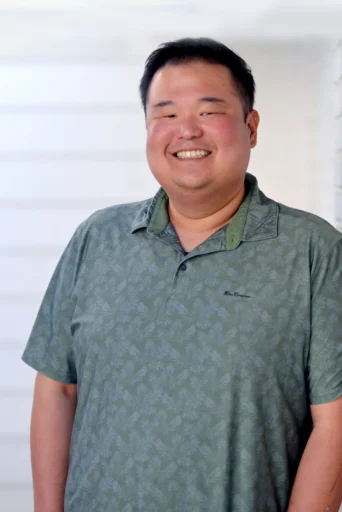
Seung Hwan “Fred” Ra, M.M., MT-BC, is a board-certified music therapist at NewCircle with 10 years of experience in settings that include neonatal intensive care, special education and hospice. He is completing a PhD in Music Education with an emphasis in Music Therapy at the University of Miami, where he provided music therapy to children and young adults with eating disorders at Nicklaus Children’s Hospital. He is also an Adjunct Professor at the University of Alabama at Birmingham. Outside of work, Fred enjoys fishing and spending time with his wife and five dogs.